
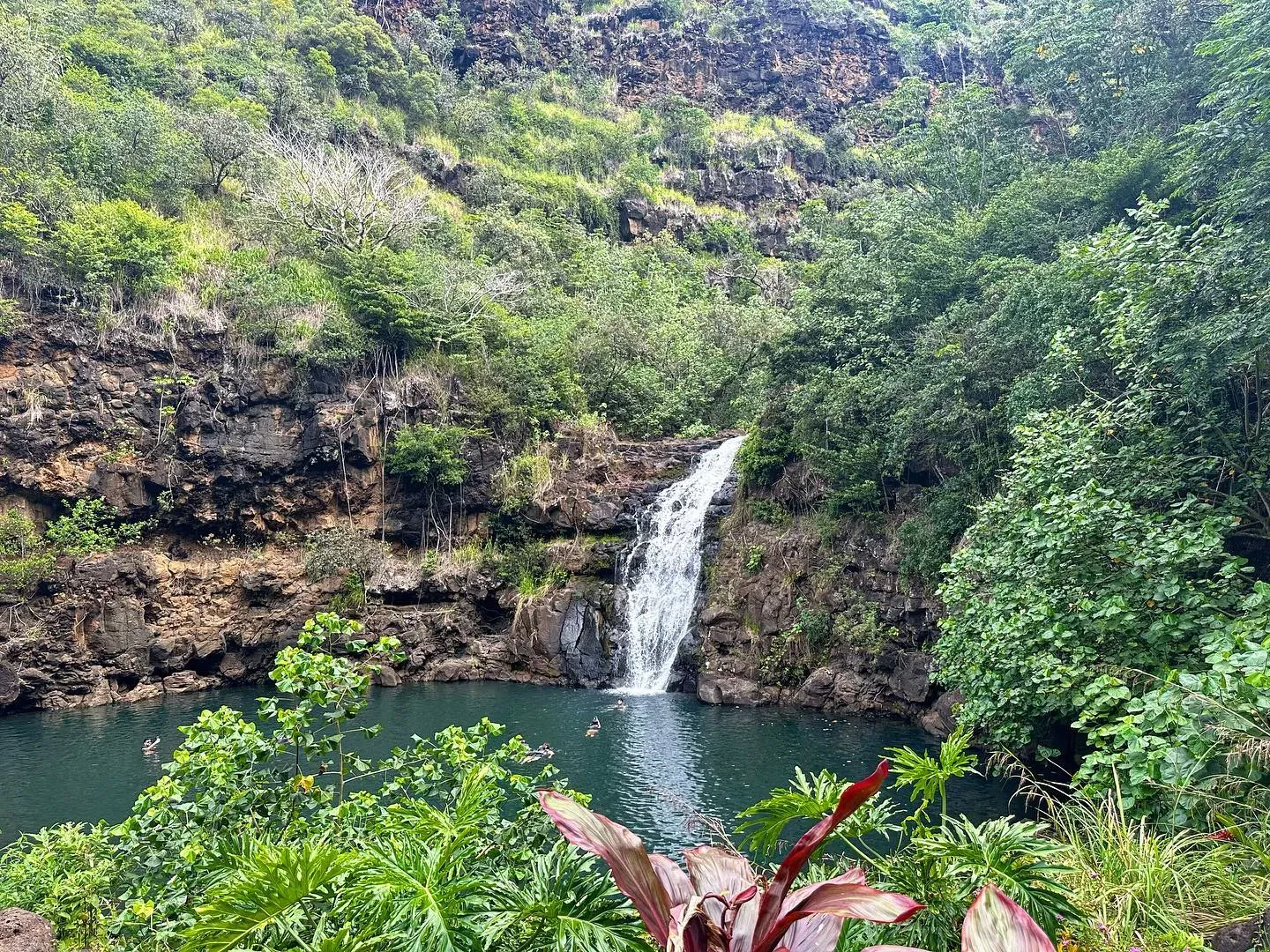
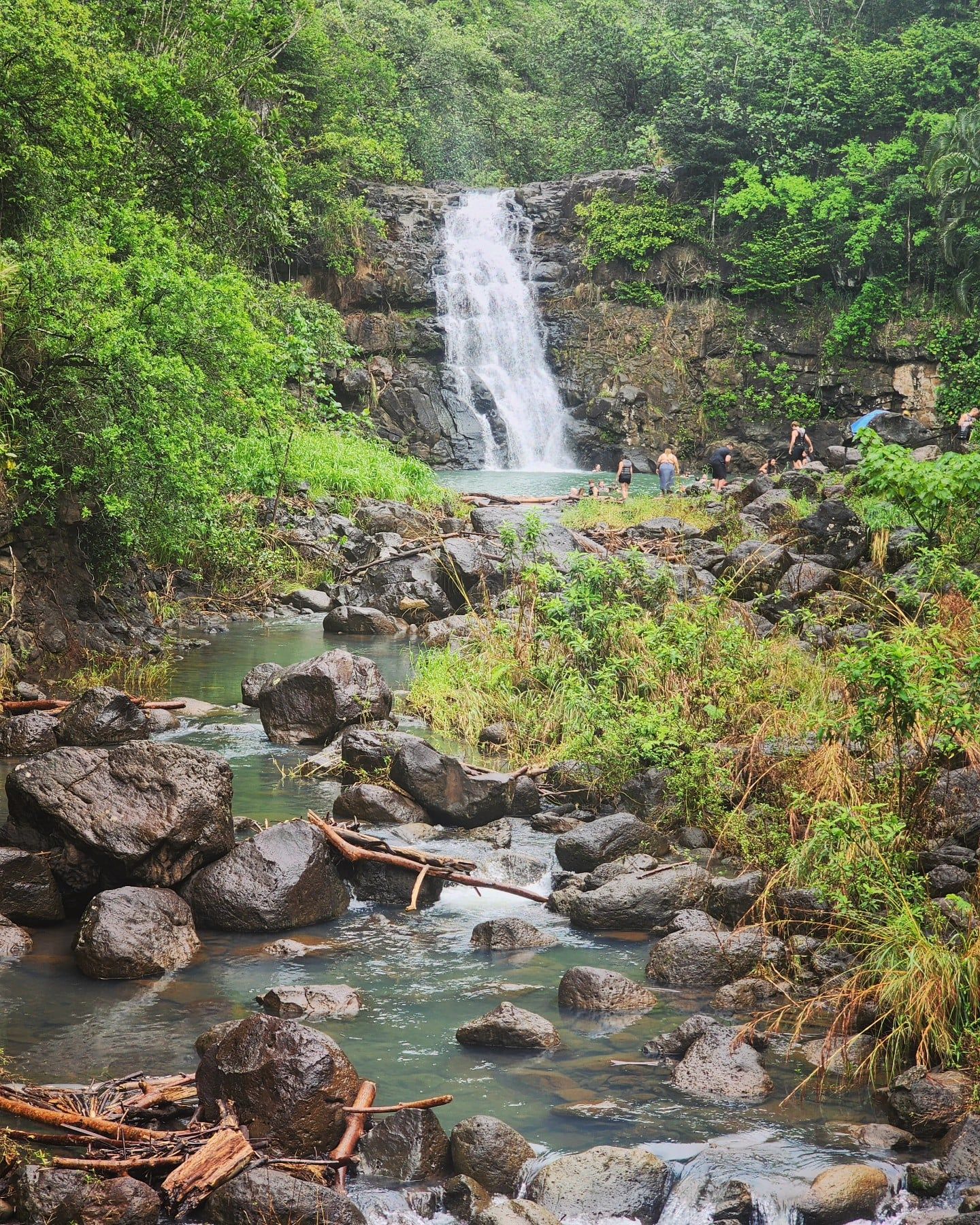
Waimea Falls drops 45 feet into a natural swimming pool at the back of a 1,875-acre botanical garden on Oahu's North Shore. The 0.75-mile paved trail to the water passes through 60 themed plant collections and preserved Hawaiian archaeological sites.
Waimea Falls drops 45 feet down a basalt cliff into a freshwater pool on Oahu's North Shore. Known traditionally as Waihi Falls, the cascade marks the end of Kamanui Stream's journey through the 1,875-acre Waimea Valley. Visitors reach the water by walking a 0.75-mile paved trail. The path cuts through 60 distinct botanical gardens managed by the Native Hawaiian non-profit Hiʻipaka LLC.
Driving to the valley from Waikiki takes about 90 minutes. You park in one of two free lots located 0.4 miles off Kamehameha Highway, just across from the famous Waimea Bay. The public bus takes nearly three hours and requires multiple transfers. Go Waikiki Shuttle offers a direct flat-rate service in Mercedes Sprinter vans for those who want to avoid driving.
Thick canopies of monkeypod trees shade the walkway once you pass the ticket booth. Near the Wahi ʻĀina Snack Bar, peacocks roam freely across the grass. As you move deeper into the valley, the air grows noticeably cooler and smells of damp earth. You hear the rush of water long before the final bend reveals the falls. At the pool's edge, lifeguards hand out required life jackets to anyone entering the water.
Heavy rains can turn the normally calm green pool into a dangerous surge of brown water. When currents become unsafe or water quality drops, lifeguards close swimming access immediately. Check the official website or call the visitor center at 9:00 AM on the day of your trip to confirm the pool is open. Even if swimming is prohibited, you can still walk the trail and view the waterfall from the wooden observation deck.
Summer months bring the best conditions for visiting. During June, July, and August, the valley hosts a Summer Concert Series with live music and local food vendors. The warmer weather makes the cold plunge into the waterfall pool much more tolerable. Winter storms, by contrast, bring heavy rains that frequently close the pool. If you finish your hike early, Haleiwa Town sits 15 minutes down the road, offering shave ice and local burgers.
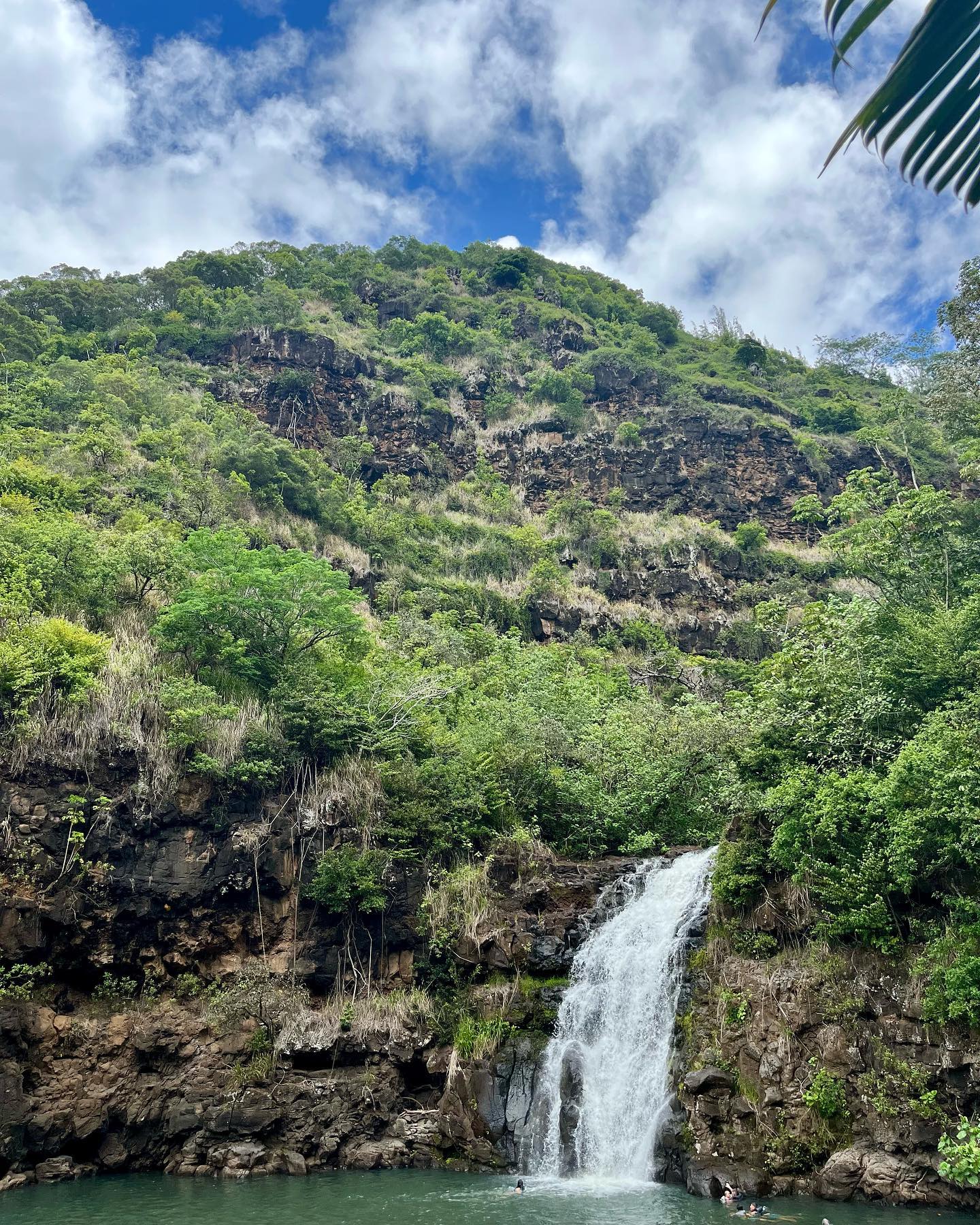
Ancient Hawaiians established a highly prosperous farming community in Waimea Valley centuries before Western contact. Due to the nutrient-rich volcanic soil and constant rainfall, the area offered ideal conditions for cultivating pink taro root stock. This specific crop held immense value and was strictly reserved for the Aliʻi, the Hawaiian elite. Along the Kamanui Stream, priests and farmers built extensive stone terraces and living complexes. The valley supported thousands of residents who utilized the ahupuaʻa system to manage resources from the mountain ridges down to the ocean.
High priest Hewahewa controlled the valley until his death in 1837. Ownership then passed to his granddaughter Paʻalua. Following the Mahele Land Redistribution Act of 1848, the territory was divided, leaving Paʻalua with roughly half the original acreage. Mounting debts eventually caught up with her. By 1884, she mortgaged and leased the property, triggering a century of rapid transitions. Ranchers ran cattle through the lower valley, trampling ancient agricultural terraces. To generate income, farmers planted commercial crops to sell in Honolulu. During the early 1900s, the military occupied sections of the land, building temporary structures and roads.
Commercial tourism arrived in the 1960s and 1970s. Operators branded the area as the Waimea Falls Ranch and Stables. From the rocks above the 45-foot drop, visitors paid to watch cliff-diving exhibitions. Hula shows took place on the lawns, and guided horseback tours tore up the dirt trails. Because the focus shifted heavily toward entertainment rather than preservation, several historical sites suffered degradation.
The Native Hawaiian non-profit organization Hiʻipaka LLC took over management in the modern era. They eliminated the cliff-diving shows and restored the focus to ecological and historical preservation. Throughout the grounds, workers cleared invasive species and rebuilt damaged archaeological structures. Today, visitors can join the Kaʻapuni o Waimea program. This self-guided journey directs guests to specific historical markers throughout the valley. Participants who complete the route receive a Cultural Ambassador pin at the Hale Hoʻike desk.
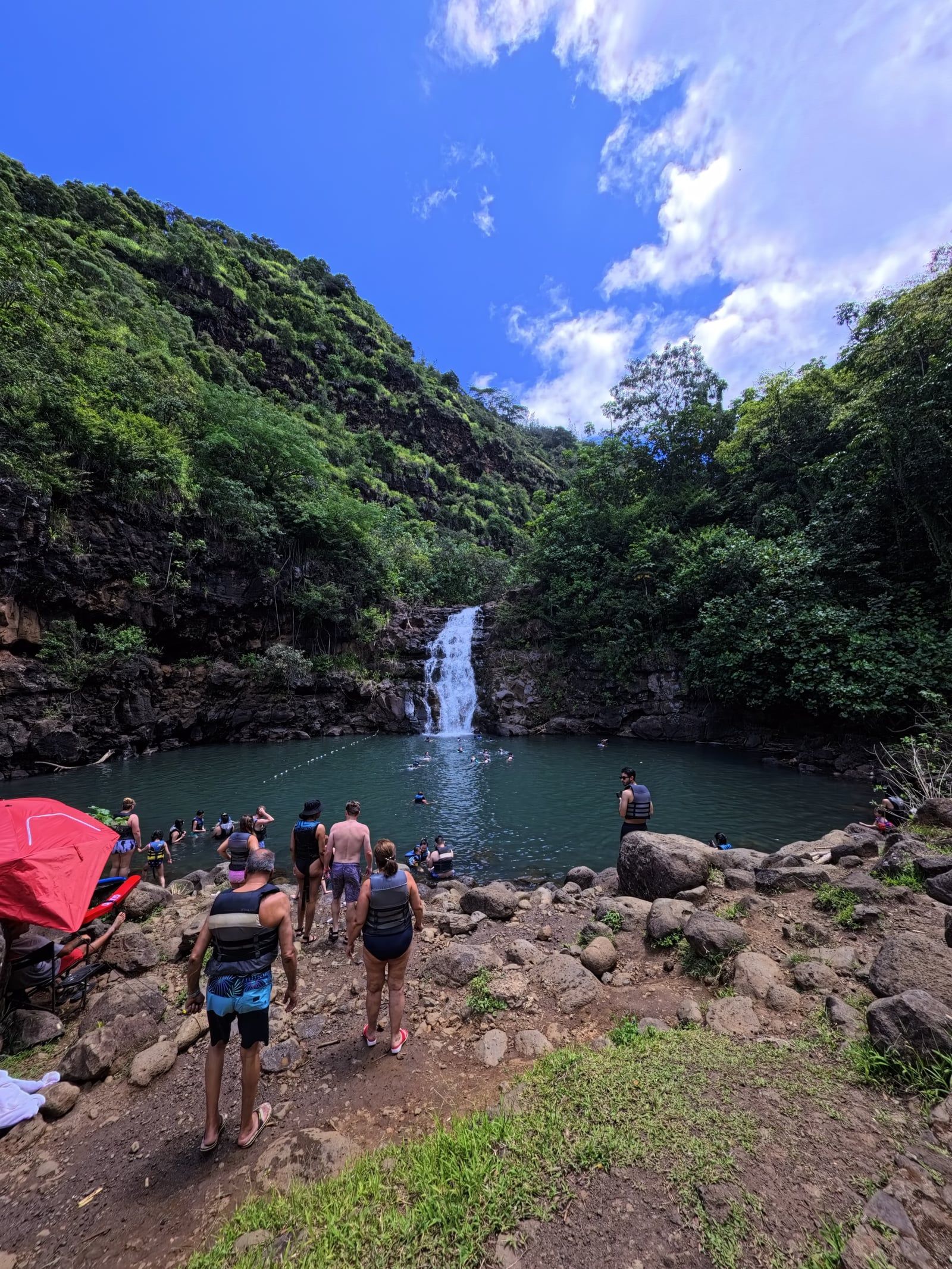
Forty-five feet of dark basalt rock form the sheer cliff face of Waimea Falls. Spilling over this volcanic ledge, the Kamanui Stream drops straight down into a plunge pool that reaches depths of 30 feet near the center. The water temperature hovers in the low 70s Fahrenheit year-round. Along the shallow edges of the pool, jagged, submerged rocks create a hazard. Swimmers routinely scrape their feet wading in without protective water shoes. During rare dry summers, the flow slows to a trickle or stops entirely, exposing the dark rock wall behind the cascade.
The surrounding 1,875-acre valley functions as a traditional ahupuaʻa. Running from the peaks of the northern Koolau Mountains directly down to the ocean at Waimea Bay, this ancient land division system sustained the local population. The layout ensured early inhabitants had access to timber, freshwater, agricultural land, and marine resources within a single boundary. Spanning approximately 0.75 miles in length, the valley floor provides a flat, sheltered environment protected by steep ridges on either side.
Sixty distinct botanical collections flank the paved trail leading to the waterfall. Featuring gentle slopes and wide concrete sections, the path accommodates wheelchairs and mobility scooters. The gardens contain rare and endangered Hawaiian flora alongside tropical species from Madagascar, Seychelles, and Guam. In the lower ponds, giant Victoria water lilies float on the surface. Dense clusters of bamboo tower over the middle sections of the path. Every Saturday from 8:00 AM to 12:00 PM, the non-profit hosts a plant nursery sale. Local horticulturists sell propagated plants and provide specific care instructions for growing tropical species at home.
An electric shuttle service runs constantly between the ticket booth and the waterfall observation deck. For $10 one-way or $20 round-trip, visitors can skip the walk entirely. The vehicles provide an alternative for those who cannot manage the slight uphill grade of the 0.75-mile trail. Just below the falls, you will find restrooms, shaded seating areas, and locker rentals. You can store your wallet and phone in the lockers before walking down the final set of stone stairs to the water's edge.
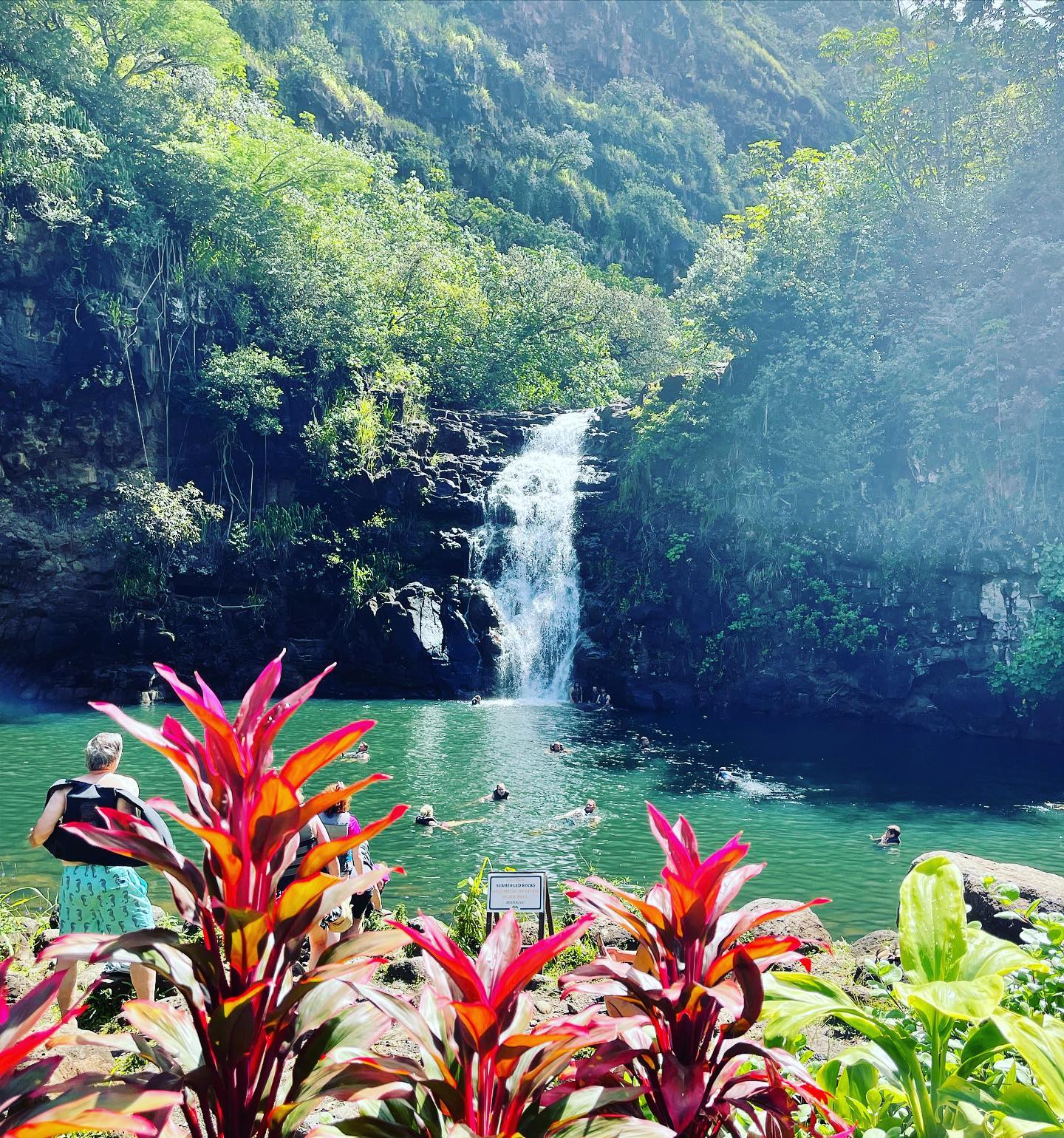
Waimea translates to 'red water' in Hawaiian. The name references the red volcanic dirt that washes down from the mountains during heavy storms, staining the stream and the bay. Across the islands, Native Hawaiians consider the entire valley a wahi pana, a storied and sacred place. For over seven centuries, the land served as the historic home of the kahuna nui, the high priests of Oahu. These spiritual leaders advised kings, conducted ceremonies, and managed the complex religious laws governing the island.
Oahu's largest ancient heiau, or temple, sits on a ridge overlooking the valley floor. Stone walls and terraces mark the remains of this massive religious structure. Lower down the trail, visitors walk past a reconstructed traditional living complex. The thatched-roof hale structures demonstrate how early inhabitants organized their daily lives. According to strict kapu laws, builders separated sleeping quarters from cooking areas, dictating every aspect of social and religious behavior.
The valley continues to function as a center for Hawaiian cultural education. Near the visitor center, practitioners host the Toa Lūʻau, preparing traditional foods in an underground imu oven. After spending the day in the gardens, guests watch fire knife dances and hula performances. Free botanical tours depart daily at 12:30 PM. Guides point out specific plants used by early Hawaiians for medicine, canoe building, and weaving.
Park rules enforce the sacred nature of the site. Past the ticket booth, security prohibits alcohol, and the entire valley operates as a smoke-free and vape-free environment. To protect the archaeological sites hidden in the underbrush, visitors must stay on the marked concrete paths. You cannot climb on the rocks surrounding the waterfall or dive into the pool. These restrictions prevent injuries and maintain the physical integrity of the natural formations.
Park management strictly prohibits the use of drones anywhere in Waimea Valley to protect wildlife and guest privacy.
Lifeguards require every swimmer to wear a provided life jacket before entering the 30-foot-deep waterfall pool.
The freshwater stream carries Leptospirosis bacteria, prompting warnings to keep water out of your mouth and avoid swimming with open cuts.
Visitors must scrape mud off their shoes and spray them with 70% rubbing alcohol to prevent the spread of Rapid ʻŌhiʻa Death fungus.
The 45-foot waterfall occasionally slows to a mere trickle or stops completely during rare summer droughts, as seen in late 2025.
Dozens of peacocks wander the lower lawns and parking areas, often displaying their feathers near the ticket booths.
Hawaii residents pay only $10 for entry and receive completely free admission on King Kalākaua’s Birthday with a valid state ID.
The paved trail is 0.75 miles each way, making it a 1.5-mile round trip. Most visitors take 1 to 2 hours to walk the path, view the gardens, and see the waterfall.
General admission is $26 for adults. Seniors and students pay $20, while children aged 4 to 12 cost $18.
Swimming is allowed in the 30-foot-deep pool when conditions are safe. Lifeguards assess the water quality and current strength every morning at 9:00 AM to determine if the pool will open.
An electric shuttle runs between the visitor center and the waterfall. Tickets cost $10 per person for a one-way ride and $20 for a round trip.
Pets are not permitted anywhere in the valley. Only ADA-certified service animals on leashes can enter the grounds.
Water shoes are highly recommended. The submerged rocks near the edge of the pool are sharp and slippery, causing frequent foot scrapes for barefoot swimmers.
Two parking lots located 0.4 miles off Kamehameha Highway offer free parking for all visitors. You only pay for admission at the ticket booth.
Flash floods can cause the stream to swell rapidly. Lifeguards will immediately close the pool and order all swimmers out of the water until the surge passes.
Restrooms and changing areas are located near the viewing deck at the falls. Visitors can also rent lockers to store dry clothes and electronics while swimming.
The 0.75-mile path is fully paved and wide enough for wheelchairs and mobility scooters. However, there is no paved ramp leading directly into the natural swimming pool.
Browse verified tours with free cancellation and instant confirmation.
Find Tours